
Perspective
Seattle’s school closure plan still looks half-baked
Seattle Public Schools is weighing mergers involving 21 schools. Families deserve to know what their children would gain, what they’d lose, and what SPS can afford to deliver.
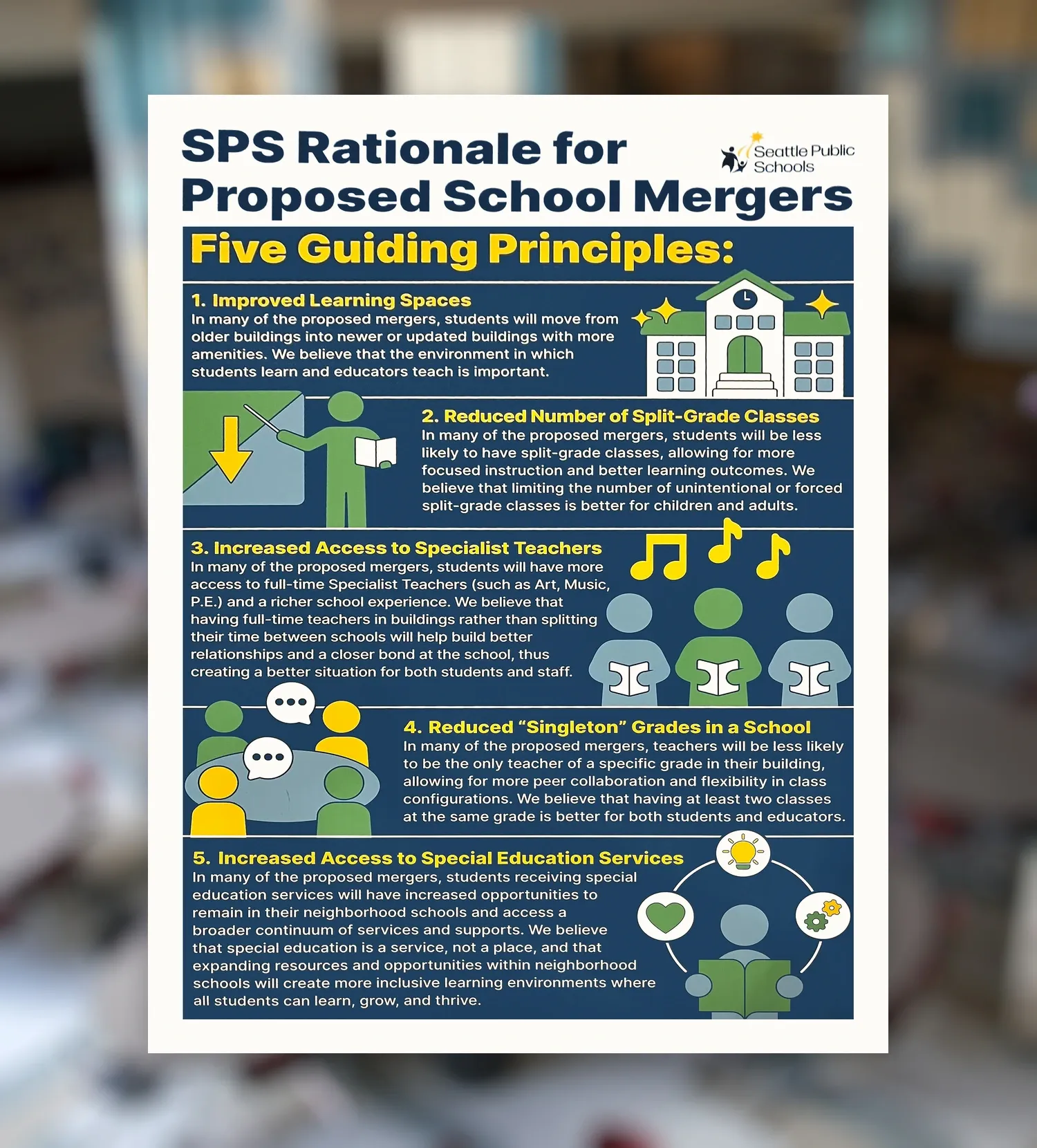
In October, Superintendent Ben Shuldiner told families he wanted to avoid bringing the School Board a “half-baked plan.”1 SPS is now weighing mergers involving 21 schools for 2027–28.2 The district’s handout makes five claims about what students and teachers would gain.
At Highland Park on Nov. 16, families asked how a merger with Sanislo would affect class sizes, staffing, developmental preschool and per-student funding. Shuldiner said staff would keep their district jobs and the principals would share leadership in year one. Who would lead in year two was still unsettled.3
We think the plan is still half-baked. SPS’s five arguments don’t justify closing schools.
Families, educators and neighbors should ask SPS and the School Board what’s driving these closures and what the district has tried to keep schools open. Tell the board to oppose closures until SPS can show why they’re needed.
Seattle still has the kids
Shuldiner opened his letter by comparing more than 94,000 SPS students in 1964 with fewer than 50,000 today.1 The district’s own history traces that unusual enrollment peak to the baby boom and annexation.
By 1980, nearly 90% of the drop in Seattle’s school-age population from 1960 to 1990 had already happened, mostly in the 1970s. The number of children ages 5–17 grew over the three decades after 1990 and has hovered around 76,000 since 2019. That’s about 12,000 more school-age children than Seattle had in 1980.4
That puts Seattle in a different position from several other major cities. From 2019 to 2024, the estimated number of residents ages 5–17 fell about 11% in Portland, 7% in Los Angeles and 5% in Chicago. Seattle held near 77,000 over that same period.5 SPS has children here to serve and families it can win back.
-
Seattle residents ages 5–17, 2025 vs. 19906
- 34% more
- To private and charter schools, 2025 vs. 2010 (Seattle estimate)
- 4,700 lost
In 1970, 13.3% of Seattle’s K–12 students attended private school. The Census puts that share at about 17% in 1960, 19% in 1980 and 21% in 1990 and 2000.7 The chart uses all residents ages 5–17 as its denominator, including children who weren’t enrolled. By that measure, an estimated 12.7% attended private school in 1970. From 2010 to 2025, the estimated share attending private or charter schools rose from 21.5% to 24.5%. That’s about 4,700 additional children attending private or charter schools.8
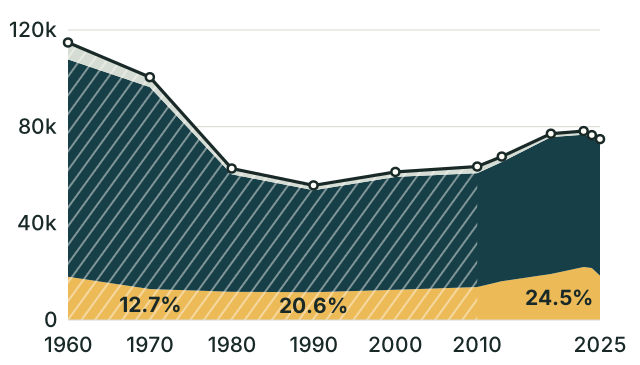
- Private + charter
- Public, excluding charters
- Not enrolled
- Historical estimates
Read the chart data
| Year | Public* | Private + charter | Not enrolled | Total |
|---|---|---|---|---|
| 1960 | ≈89,900 | ≈17,900 | ≈7,000 | 114,826 |
| 1970 | ≈83,600 | ≈12,800 | ≈4,100 | 100,482 |
| 1980 | ≈48,600 | ≈11,700 | ≈2,400 | 62,687 |
| 1990 | ≈42,200 | ≈11,500 | ≈2,000 | ≈55,700 |
| 2000 | ≈46,700 | ≈12,500 | ≈2,100 | 61,276 |
| 2010 | 47,112 | 13,645 | 2,742 | 63,499 |
| 2013 | 49,332 | 16,057 | 2,244 | 67,633 |
| 2019 | 56,658 | 19,046 | 1,394 | 77,098 |
| 2023 | 54,755 | 21,927 | 1,500 | 78,182 |
| 2024 | 53,834 | 21,484 | 1,194 | 76,512 |
| 2025 | 55,224 | 18,338 | 1,286 | 74,848 |
Historical enrollment figures are rounded. We apply the private share of school enrollments to the estimated number of residents ages 5–17 in school. We use the K–12 count for that enrollment total in 1960 and interpolate the enrollment rate from 1970 to 2000 for the 1980 and 1990 estimates.
* The public column excludes charters and includes public schools across district lines. The chart moves the Seattle charter-campus count from public to private + charter as an approximation. The Census estimates carry survey margins.
Shuldiner’s own letter acknowledges that closure threats can push families toward private schools, public charters and other districts.1 To win those families back, SPS should compare each merger with a funded plan to improve the schools children already attend.
 1. Better buildings
SPS says many mergers would move students from older buildings to newer or renovated ones with more amenities.
Sacajawea’s roof and some classrooms had leaked on and off for about 30 years despite repeated repairs, its principal told the city in 2022. An assessment SPS commissioned recommended replacing the building. John Rogers, the school that could receive Sacajawea students, opened a new building in 2025.9
Voters approved money to design Sacajawea’s replacement in 2019. SPS froze the design work in 2024 while weighing closures and kept the remaining funds earmarked for the project.10
- Estimated design funding voters approved for Sacajawea
- $4 million
- Spent on planning by November 2024
- Under $400,000
The 2025 levy set aside $150 million to replace one aging northeast Seattle elementary school. SPS left the school unnamed and still lists Sacajawea’s design as on hold.11
SPS helped create the gap in building conditions it now cites as a reason to move children.
SPS modernized Licton Springs’ 1908 Webster building in 2020 with seismic upgrades, new building systems and a gym.12 If a merger moves Licton Springs students out of Webster, they would leave behind the kind of upgraded school building SPS is using to sell mergers.
 2. Fewer split-grade classes
SPS says many mergers would mean fewer split-grade classes. It argues that reducing forced splits would improve instruction and learning.
A research review found little difference in learning outcomes on average. In a national U.S. study, first graders in mixed- and single-grade classes did about as well in reading and math after researchers accounted for prior achievement.13 In Scotland, younger children who shared a classroom with older peers made short-term gains in literacy and numeracy.14
Montlake, which could receive Stevens students, built the Montlake Model around team-taught, multi-age classrooms and smaller reading groups. It still uses flexible reading and math groups and highlights its Walk to Math program.15
Salmon Bay, paired with Licton Springs, touts mixed-age learning as a way to teach children to look out for each other. Its handbook describes a combined kindergarten–first grade class and seventh- and eighth-grade teams that share most core classes.16
On average, split-grade classes make little difference to learning. Let parents weigh their concerns against what their children gain at a small school.
 3. More access to art, music and PE
SPS says many mergers would give students more access to full-time specialists. It argues that teachers based at one school can build stronger relationships with students.
Hiring another art, music or PE teacher takes funding for another position. A merger can combine two half-time jobs into one full-time job using the same staffing budget. SPS funds elementary specialists to cover classroom teachers’ planning time and gives PE, music and visual art first claim on those hours.17
Working in one building can free up time a specialist used to spend traveling. A larger school can also give each specialist more classes to cover. If the number of classes grows faster than the hours available to teach them, some children may get shorter or fewer lessons.
A specialist can work a full week in one building and still see each class less often.
 4. More colleagues who teach the same grade
SPS says many mergers would give teachers a colleague who teaches the same grade, making it easier to collaborate and giving schools more flexibility to arrange classes.
A study involving more than 9,000 Miami-Dade teachers linked stronger collaboration across a school’s faculty to larger gains in reading and math.18 At Highland Park, teachers already plan across grades to tailor instruction for advanced learners.19
Good collaboration takes regular time to plan and the trust that teachers, school leaders and families build over years. In a long-term study of Chicago elementary schools, educators in schools with stronger trust were more willing to try new approaches and work with families to improve their schools.20
Many teachers want to stay in the school communities they’ve helped build. A merger can break up those teams. A study of North Carolina elementary school closures found that departures from public-school teaching rose most among experienced teachers.21
SPS should survey parents and teachers at each affected school. Ask families what they value and whether they’d enroll at the merged school. Ask teachers how the move would affect their work and whether they’d follow their students, transfer elsewhere or leave SPS.
Publish the survey questions, response rates and results by school before the board votes. The board and the public should be able to judge how much support SPS has earned from parents and teachers in each affected community.
 5. More special education services close to home
SPS says many mergers would let more students receive special education in their neighborhood schools and give them access to a wider range of supports.
Sacajawea and John Rogers both offer Extended Resource. It can include extra instruction and support with schoolwork, social skills and daily activities, in regular classrooms or in small groups. Sacajawea also offers Distinct for students who need a substantially different curriculum. That can mean individualized teaching in academics, communication and daily living skills.22
The district’s 2026–27 budget projects two teachers and four instructional assistants for Distinct at Sacajawea and zero at John Rogers.23 To keep those services at the merged school, SPS would need a team there that can teach that curriculum. Some children could otherwise need a different school and a longer ride.
The stakes are especially high for medically fragile students. SPS lists Orca K–8, another school in the merger talks, as a site with a full-time nurse for children who need regular skilled care. Depending on the child, a move could require arranging nursing care throughout the school day and on the bus.24
Other students rely on speech or occupational therapy, communication devices or accessible transportation. A move can disrupt several of those supports at once. Even a short gap can mean missed lessons or days away from school.25
Federal rules require placements to follow each child’s individualized education program (IEP) and be as close to home as possible. Parents take part in those decisions.26 Before a move, families need to know where their child will get each service, who will provide it and how they’ll get there. That takes staffing and funding that meet children’s needs.
 What the public should require of the School Board
Tell the School Board to oppose closures unless SPS can show that at least one of these conditions holds.
- SPS has tried every reasonable alternative. The district can show which options it tried to keep the school open, how much time and support it gave each, and why those efforts fell short.
- The closure is part of a long-term plan. The public helped shape it over several years. SPS shared the options in advance and set clear milestones for reviewing progress and making decisions.
- The affected school communities support it. Surveys show that parents and educators back the plan. Publish the questions, response rates and results by school so the public can judge that support.
Pittsburgh’s school board voted to close 12 schools in hopes of giving more students access to programs such as eighth-grade algebra. The New York Times reported that Arsenal Middle School hopes to offer algebra once more students arrive. On The Daily, parents described the care their children already get at schools slated to close and asked whether the district would deliver the programs it was promising.27
After Chicago’s 2013 closures, University of Chicago researchers found that upgrades at some receiving schools came late or fell short. Two of the six receiving schools they studied went without the libraries they’d been promised. For students whose schools closed, reading scores returned to expected levels in the second year, while math scores were still about two months of learning below expectations in the fourth year. When promised improvements fall short, families have one more reason to doubt the district the next time it asks them to move.28
Washington supplies most of Seattle’s school funding, and local levies already help cover gaps in services such as special education. SPS drew on its fund balance to close the 2026–27 budget gap and says the structural deficit persists. Before promising more services, the district should show what it can fund year after year and what it can deliver if additional state money falls short or positions go unfilled.29
Publish a 10-year vision for Seattle’s public schools
SPS should show what it wants every child to get from a Seattle public school today and over the next decade. Start by funding art, music and PE and filling special education jobs where children already learn. Invite families to see what their schools offer. Set annual enrollment and retention goals and report progress by school.
Tie capital spending to that vision. Publish which schools SPS plans to repair, renovate or replace, how each project serves students, what it will cost and when work will happen. Explain in public when projects are delayed or funds are redirected.
Spell out when SPS would consider a future closure or merger. Publish the thresholds for enrollment and building use, how long those conditions must last, and how the district would measure the full costs and effects on students. Review those criteria in public before naming any schools.
Families need time to plan where their children will go to school. Educators, child care providers, after-school programs and neighborhood groups make plans around those schools, too. Give the whole community a chance to shape the vision and set priorities before the board commits money or makes decisions about schools.
SPS should keep these schools open and give families a reason to choose them.
Tell the board to vote no on closures
Tell directors what your school does for your neighborhood. Ask them to publish a 10-year vision that ties capital spending to what Seattle wants for its children and spells out when SPS would consider future closures or mergers.
Footnotes
-
Ben Shuldiner, Oct. 25 letter to Seattle Public Schools families. ↩ ↩2 ↩3
-
KUOW, Seattle Public Schools confirms 21 schools are up for potential merger (Oct. 27, 2026) and interview with Ben Shuldiner (Nov. 9, 2026). ↩
-
Tracy Record, West Seattle Blog, report on the Highland Park–Sanislo family meeting (Nov. 17, 2026). ↩
-
SPS, Building for Learning, historical overview, on the postwar enrollment peak. Population benchmarks for Seattle residents ages 5–17 come from the 1972 University of Washington and SPS report, Table IX-2, the 1980 Census advance estimates, Table P-2, Seattle’s 1990 Census profile and 2000 Census profile, Table PCT23, and one-year ACS table B01001 for 2010, 2019, 2024 and 2025. The 2019, 2024 and 2025 estimates overlap within their survey margins. ↩
-
U.S. Census Bureau, American Community Survey one-year estimates, table B01001 for 2019 and 2024. Sum cells E004–E006 and E028–E030 for ages 5–17 within each city’s limits. Seattle: 77,098 to 76,512. Portland: 83,204 to 73,819. Los Angeles: 575,447 to 534,061. Chicago: 392,627 to 372,086. ↩
-
The 1990 Census, Table 61, Seattle city counted 55,661 residents ages 5–17. The 2025 American Community Survey, Table B01001, Seattle city estimates 74,848. Subtracting the 1990 count and dividing by it gives 34.47% growth, rounded to 34%. ↩
-
U.S. Census Bureau, Seattle city columns in 1960 Seattle census tracts, Table P-1, 1970 Washington, Table 83, 1980 Washington advance estimates, Table P-2, 1990 Washington social and economic characteristics, Table 3, and 2000 Seattle profile, Tables P36 and PCT23. The 1990 private share covers elementary and high school. The table lists preprimary enrollment separately. ↩
-
U.S. Census Bureau, American Community Survey one-year estimates for Seattle city, table B14003 in 2010, 2013, 2019, 2023, 2024 and 2025. We sum ages 5–9, 10–14 and 15–17 for both sexes in each enrollment group. We use charter counts from the SPS 2024 demographic report and the Washington State Board of Education 2026 charter report, Appendix A. These counts describe students attending charter campuses in Seattle and serve as a rough proxy for Seattle children attending charters. The percentage divides the combined group by all Seattle residents ages 5–17. ↩
-
SPS, John Rogers ribbon cutting (2025). Seattle Landmarks Preservation Board, July 20, 2022 minutes. SÄZÄN Environmental Services, facilities assessment for SPS (2022). ↩
-
SPS, BEX V capital levy program (2018), levy information session (Nov. 7, 2024) and levy oversight minutes (Nov. 8, 2024). ↩
-
SPS, Sacajawea project status and approved BEX VI levy (2025). ↩
-
Simon Veenman, Effects of Multigrade and Multi-Age Classes Reconsidered (1996). Jaime L. Thomas, national study of first graders in combination classes (2012). David Sims found lower scores for some students placed in combination classes during California’s class-size reduction program (2008). ↩
-
Daniel Borbely and colleagues, Early Years Multi-grade Classes and Pupil Attainment (2023). ↩
-
SPS, Montlake school history. Education Week, A Seattle Principal Defies the Conventional Wisdom (1988). Montlake Elementary, family handbook (revised Sept. 2026) and school profile. ↩
-
Salmon Bay K–8, school improvement plan and student handbook. ↩
-
SPS, 2026–27 school budget instructions, Preparation–Conference–Planning Allocation. ↩
-
Matthew Ronfeldt and colleagues, Teacher Collaboration in Instructional Teams and Student Achievement (2015), especially Tables 7 and 8 on schoolwide and individual collaboration. ↩
-
SPS, Highland Park Elementary school improvement plan, under Advanced Learning and Highly Capable Services. ↩
-
Anthony S. Bryk and Barbara Schneider, Trust in Schools: A Core Resource for School Reform (2003). ↩
-
Andrew J. Hill and Daniel B. Jones, The Effect of School Closings on Teacher Labor Market Outcomes and Teacher Effectiveness (2021). ↩
-
SPS, Placement and Primary Service Types, descriptions of Extended Resource and Distinct. ↩
-
SPS, 2026–27 elementary service chart and budget projections for Sacajawea and John Rogers. ↩
-
SPS, full-time nursing sites and extraordinary nursing needs, including transportation. ↩
-
The Daily, Public Schools Have a New Crisis: Not Enough Students (Nov. 11, 2026). Sarah Mervosh and Jack Healy, The New York Times, Schools Are Closing Nationwide as Enrollment Drops. Parents Are Livid. (Nov. 17, 2026). ↩
-
University of Chicago Consortium on School Research, School Closings in Chicago (2018). See the receiving-school facilities findings. ↩
-
SPS, General Budget Information, Operations Levy and 2026–27 Adopted Budget. ↩